How AI Is Changing Sports Betting in 2026: From Odds Comparison to Smarter Analysis
AI is changing how bettors compare odds, process sports data and research betting opportunities in 2026. But better analysis does not eliminate uncertainty or guarantee profitable bets.

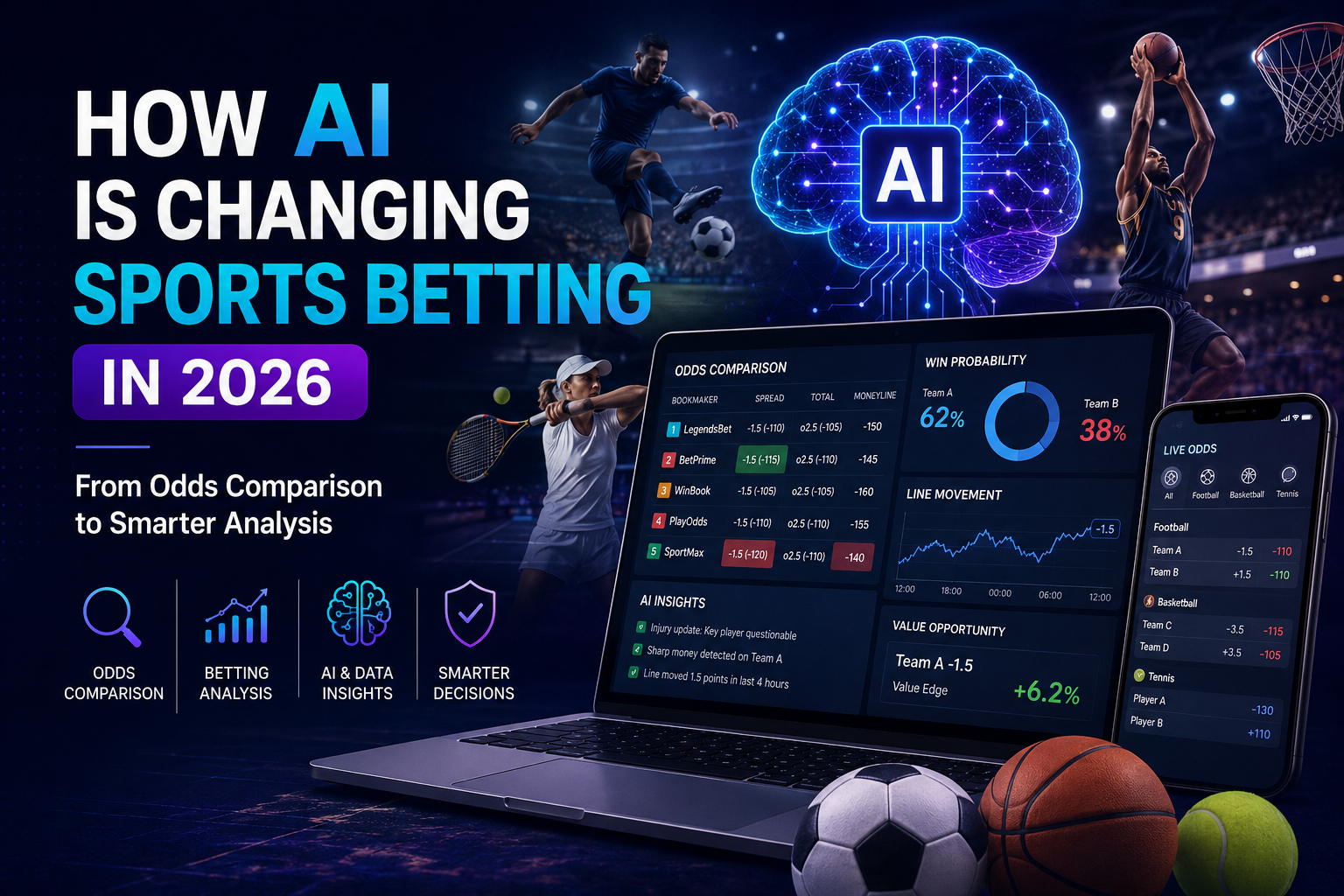
A bettor opening a sportsbook app today is looking at prices that were, in a real sense, set by a machine seconds earlier. On the other side of that same transaction, a growing number of bettors are using AI tools to scan the odds, pull together injury reports, and flag line movement across a dozen books before placing a single wager. Both sides of the market have gotten faster and more automated. Neither side has gotten more certain.
That's the useful way to think about AI's role in sports betting in 2026: it is an information-processing upgrade, not a forecasting breakthrough. AI systems can ingest more data, compare more prices, and surface patterns faster than a person working alone. What they cannot do is eliminate the randomness inherent to sport, overcome the built-in margin bookmakers price into every line, or turn a probability estimate into a guaranteed outcome.
AI Is Changing the Betting Research Process
The most immediate change for ordinary bettors is upstream of any single wager: how research gets done. Comparing odds across multiple sportsbooks used to mean opening several tabs and checking prices by hand. That process is increasingly automated, with tools capable of aggregating dozens of live feeds simultaneously and converting between decimal, fractional and American odds formats into a single comparable view.
Sports data analysis has followed a similar trajectory. Instead of a bettor manually tracking a team's recent form, injury news and scheduling fatigue, machine learning systems built specifically for tabular and time-series sports data — gradient-boosted decision tree models like XGBoost and LightGBM, alongside time-series methods that weight recent form more heavily than older results — now do much of that aggregation automatically, pulling in variables ranging from rest days and travel distance to weather conditions and advanced per-play metrics.
From Searching for Odds to Asking Better Questions
The way bettors interact with this information is also shifting. Where a bettor once searched for "NFL odds this week" and scanned a results page, a growing share of that research now happens conversationally — asking a system to compare specific lines, explain why odds moved, or summarize injury news for a particular matchup. This mirrors a broader change in how people research information online generally, where generative search increasingly answers questions directly rather than pointing to a list of links to click through.
The same shift is visible in other parts of online gambling, where AI-assisted search is changing how players discover, compare and evaluate casino operators as well. Level.casino has examined this development in its analysis of how AI-powered search is changing online casino reviews, looking at how conversational search is reshaping discovery well beyond sports betting specifically.
How AI Can Compare Sports Betting Odds
Odds aggregation tools work by ingesting live price feeds from many bookmakers at once and normalizing them into a common format, which lets a bettor see at a glance where a particular line is priced most favorably. More advanced systems track the speed and direction of line movement, which can reveal "steam moves" — rapid, coordinated shifts in a price that often reflect sharp money entering the market — before a casual bettor would otherwise notice.
This kind of tooling has real limitations that are worth understanding before relying on it. Bookmaker data feeds can lag by anywhere from a couple hundred milliseconds to several seconds, which means an odds comparison tool can display a price that the sportsbook has already pulled or adjusted — a "phantom" opportunity that no longer exists by the time you try to act on it. Comparison tools can also surface odds on markets that are technically suspended, such as during a VAR review or an in-play stoppage. And finding a favorable price discrepancy is not the same as being able to execute on it: sportsbooks operate their own automated risk systems that can limit stakes or restrict accounts identified as consistently finding an edge, independent of how that edge was found.
AI and Sports Data Analysis
Beyond price comparison, AI models are increasingly used to process the underlying sports data itself. This spans several distinct types of modeling: tree-based models for structured statistical data like point totals and spreads, neural network architectures for more complex pattern recognition such as player movement tracking, time-series models for weighting recent form and fatigue, and natural language processing tools for scanning injury reports, press conferences and other text-based sources for relevant signals.
The inputs these systems draw on have become more granular — environmental factors like altitude and stadium wind patterns, biometric and scheduling variables like back-to-back games and time-zone shifts, and advanced per-play metrics like expected goals or expected points added. More data and more sophisticated modeling can genuinely improve the quality of an analysis. It's a separate question — addressed below — whether a better analysis reliably translates into a profitable bet.
Probability Is Not the Same as Prediction
This is the single most important distinction in evaluating any AI betting tool, and it's where a lot of consumer-facing marketing gets misleading. A model doesn't predict that a team will win. What it actually produces — when built and described correctly — is a probability estimate: something closer to "this model estimates a 62% chance Team A wins" than "Team A will win." Presenting a probabilistic output as a deterministic forecast is a category error, and it's one that a lot of "AI predicts the winner" content quietly makes.
Why that distinction matters becomes clear once you factor in the bookmaker's margin. A standard point-spread bet priced at -110 in American odds (1.91 decimal) requires a bettor to win 52.38% of the time just to break even — because the sportsbook's built-in margin, commonly called the vig or juice, means the true implied probability priced into the two sides of a bet adds up to more than 100%. A model that estimates a 62% win probability for one side of a matchup only represents a genuinely profitable opportunity if the odds being offered imply a probability below that 62% figure. If the market has already priced the game close to that estimate, the expected value of the bet can be at or below zero even when the model's underlying probability estimate is accurate.
Calibration and sample size compound the problem for anyone expecting AI tools to produce quick, visible results. A model that is genuinely well-calibrated at 65% accuracy is still going to lose roughly 35 times out of every 100 bets it informs. Over a short sample — 20 or 30 bets, say — normal variance can easily produce a losing stretch even from a model that is performing exactly as designed over the long run. Classification accuracy also varies significantly by sport and market type: models applied to high-scoring, data-rich leagues like the NBA have reportedly achieved moneyline classification accuracy in the roughly 67–72% range in some published analyses, while lower-scoring, draw-prone sports like Premier League soccer tend to see meaningfully lower classification accuracy, closer to 55–65%, reflecting the greater role of variance in those sports. These figures should be read as illustrative ranges from specific analyses rather than universal benchmarks, since methodology and definitions vary across studies.
The Problem With AI Betting Predictions
General-purpose AI chatbots — the kind built for open-ended conversation rather than quantitative sports modeling — carry specific risks when applied directly to betting decisions. These systems can fabricate statistics, invent past results, or describe a roster or lineup that isn't accurate, because they're generating plausible-sounding text rather than querying a verified, current database. They can also fail to register very recent developments — a late scratch, a same-day injury, an overnight lineup change — if that information isn't part of what the system has access to at the moment of the query.
Purpose-built quantitative models, the kind actually used in serious sports analytics, face a different but related risk: overfitting. A model trained on historical data can mistake random statistical noise for a real predictive signal — treating a coincidental pattern, like a team performing unusually well under some arbitrary condition, as if it were meaningfully predictive going forward, when it's really just an artifact of the specific historical sample. It's worth being clear that a general-purpose conversational AI tool and a dedicated quantitative sports model (built on something like XGBoost or a time-series framework) are different kinds of systems facing different kinds of failure modes — conflating the two, as a lot of consumer content does, obscures more than it clarifies.
How Sportsbooks Are Using AI
It's worth being direct about something a lot of consumer-facing AI betting content leaves out: sportsbooks are using AI too, and generally with more resources and more direct commercial incentive than any individual bettor. Operators use machine learning to analyze betting velocity, timing patterns and bet selection in order to identify and manage "sharp" accounts — often within seconds of unusual activity. Dynamic pricing systems adjust odds in near real time based on liability exposure and individual customer risk profiles rather than a single static line for all customers.
The scale of this shift is visible in recent B2B sportsbook technology reporting. Kambi Group, a publicly listed sportsbook technology supplier, reported in its Q2 2026 earnings that AI-driven trading systems handled more than 75% of all bets placed across its operator network by that point, with the company's overall Q2 operator trading margin rising to roughly 14%, up from about 11.5% a year earlier — figures the company reported as part of its own audited quarterly results, worth noting as a specific vendor's reported performance rather than an industry-wide standard. Separately, sports-data provider Sportradar has reported that its Alpha Odds predictive pricing product was associated with an average 11% profit increase among B2B sportsbook clients using it, according to the company's own reporting — again a vendor-reported figure describing that company's own product, not an independently audited industry benchmark. Machine learning is also used for fraud and match-fixing detection, with graph-based models used to identify coordinated multi-account betting syndicates and arbitrage patterns across large volumes of transactions.
AI and Responsible Betting
AI plays a genuinely dual role here, and the two uses pull in different directions. On the protective side, tools like Mindway AI's GameScanner are built to monitor account activity — session length, deposit acceleration, loss-chasing patterns — and flag signs of problem gambling for review or automated intervention such as a cooling-off prompt. Mindway AI, an Aarhus University spin-out, has reported that GameScanner achieves an 87% agreement rate with human expert clinical assessments in identifying problem-gambling patterns, monitoring a large base of monthly active accounts across multiple jurisdictions — again a company-reported figure worth treating as vendor-reported rather than independently peer-reviewed at that specific percentage.
On the commercial side, similar underlying technology — behavioral pattern recognition — is also used to predict when a player is likely to churn and to trigger targeted re-engagement offers or personalized promotions. The tension is real: a system built to detect a vulnerable moment for protective purposes and a system built to detect a re-engagement opportunity for commercial purposes can be drawing on very similar behavioral signals. Sending a personalized promotional push immediately after a player has just lost a bet, for instance, sits in ethically uncomfortable territory regardless of how sophisticated the targeting is. Regulators have taken note: transparency obligations under the EU's AI Act began applying from August 2, 2026, requiring that AI-generated recommendations and analytics be disclosed as such to users — part of a broader, phased regulatory rollout for AI systems in gambling and other sectors that is still evolving.
AI Search Is Also Changing Gambling Discovery
Sports bettors are not the only users encountering this shift toward conversational, AI-mediated research. Similar changes are underway in how people research casino operators — where a conversational search can summarize licensing status, bonus terms and payment information that previously required visiting several separate review pages to piece together. The underlying dynamic is the same one reshaping sports betting research: information that used to require manual aggregation is increasingly being pre-summarized by an AI layer sitting between the user and the underlying sources.
The principle that matters here carries over directly: an AI summary is only as reliable as the underlying information it's drawing from, and it doesn't substitute for verification when real money is on the line. For readers researching casino operators specifically, an independent review platform can provide a more detailed, operator-level source than a general AI-generated answer is likely to summarize completely — Level.casino's casino review section is one example of this kind of independent, operator-specific research, covering licensing, payment terms and other details that a quick AI summary might compress or omit.
What Bettors Should Check Before Trusting an AI Recommendation
A few practical checks apply regardless of which AI tool or platform is generating a recommendation:
- Is it citing a probability or a prediction? A tool that states a specific win percentage is doing something meaningfully different from one that simply names a winner — the former is at least attempting to communicate uncertainty.
- Does the stated edge survive the vig? A model's estimated probability being higher than a "coin flip" isn't enough — check whether it clears the break-even threshold implied by the actual odds being offered.
- Is the underlying data current? Late scratches, weather changes and last-minute lineup news can invalidate an analysis generated even a few hours earlier.
- Is a specific stat or roster detail verifiable elsewhere? If a tool cites a statistic or player detail that seems off, check it against an official source before acting on it — general-purpose AI systems can generate plausible-sounding but inaccurate specifics.
- Is the sample size meaningful? A short losing or winning streak, in either direction, says very little about whether an underlying model or strategy is sound.
The Future of AI-Assisted Betting Analysis
The trajectory suggested by current sportsbook technology reporting points toward further automation on the operator side — Kambi, for instance, has indicated it expects to route an increasing share of its trading volume through proprietary AI systems, with sport-by-sport expansion continuing beyond the markets already covered. On the consumer side, expect odds aggregation and data-processing tools to keep getting faster and broader in scope, covering more sports, more markets and more real-time variables.
None of that changes the fundamental math. Faster, broader information processing is a genuine improvement in research efficiency. It is not a mechanism for eliminating the bookmaker's structural margin or the underlying variance in sporting outcomes. Any forward-looking claim beyond "tools will keep getting better at organizing information" is speculative, and readers should treat marketing claims about future AI betting products with the same scrutiny they'd apply to any other promotional material.
Conclusion: AI as an Analytical Tool, Not a Guarantee
AI has made sports betting research faster and, in some respects, more sophisticated — better odds comparison, richer statistical modeling, quicker access to relevant data. What it hasn't done, and what no legitimate application of the technology claims to do, is eliminate the uncertainty that makes sport worth watching in the first place, or the structural margin that makes sportsbooks profitable businesses. A well-calibrated model still loses a meaningful share of the time. A genuine price discrepancy still has to clear a sportsbook's own risk systems to be actionable. And a probability estimate, however well-constructed, is still a probability — not a promise.
Used with that understanding, AI is a legitimately useful research tool. Used as a shortcut to guaranteed profit, it isn't — and no dataset or model changes that. Sports betting carries real financial risk regardless of how the underlying analysis was produced, and that risk is worth weighing carefully before placing any wager.
Frequently Asked Questions
Can AI actually predict sports betting winners?
No system can reliably predict outcomes with certainty. What well-built models can do is generate probability estimates — an estimated likelihood of an outcome, not a guaranteed result.
How can AI compare betting odds?
Odds-comparison tools aggregate live price feeds from multiple sportsbooks and normalize different odds formats into one comparable view, making it easier to spot where a particular line is priced most favorably — though feed latency and market suspensions mean displayed prices aren't always instantly available.
Can AI find value bets?
It can help identify situations where a model's probability estimate differs meaningfully from the implied probability in the market price. Whether that gap represents genuine value depends on the model's accuracy and whether the bookmaker's margin has already been factored in — and finding a discrepancy doesn't guarantee a sportsbook will let the bet through at scale.
Why can AI betting predictions be wrong?
Models can be poorly calibrated, trained on incomplete or stale data, or mistake random historical noise for a real pattern (overfitting). General-purpose conversational AI tools can also generate inaccurate statistics or miss late-breaking news like injury scratches.
Should bettors trust AI-generated betting advice?
Treat it as one input, not a final answer. Check whether a tool is presenting probabilities rather than certainties, verify any specific statistics against an official source, and understand that even accurate models lose regularly due to normal variance.
How does AI affect sportsbook odds?
Sportsbooks increasingly use AI to price markets dynamically based on real-time liability and risk exposure, and to identify and limit bettors whose activity patterns suggest they may have a consistent edge.
Can AI make betting profitable?
AI can improve the quality and speed of research, but it cannot eliminate the bookmaker's built-in margin or the inherent variance in sports outcomes. No credible tool or platform can guarantee betting profits, and claims suggesting otherwise should be treated with skepticism.